What is the working principle of a tubular heat exchanger
Information summary:The working principle of a tubular heat exchanger is based on the phenomena of heat conduction and convection, allowing two fluids of different temperatures to exchange heat through the tube wall without mixing, as follows:
1. Heat conduction: Heat is transferred from a fluid at a higher temperature through the pipe wall to a fluid at a lower temperature. During this process, the fluid on both si
The working principle of a tubular heat exchanger is based on the phenomena of heat conduction and convection, allowing two fluids of different temperatures to exchange heat through the tube wall without mixing, as follows:
1. Heat conduction: Heat is transferred from a fluid at a higher temperature through the pipe wall to a fluid at a lower temperature. During this process, the fluid on both sides of the pipe wall comes into direct contact with the pipe wall. Due to the temperature difference, heat is transferred from the high-temperature side fluid to the pipe wall, and then from the pipe wall to the low-temperature side fluid. This process follows Fourier's law, which states that the amount of heat per unit area per unit time is proportional to the temperature gradient.
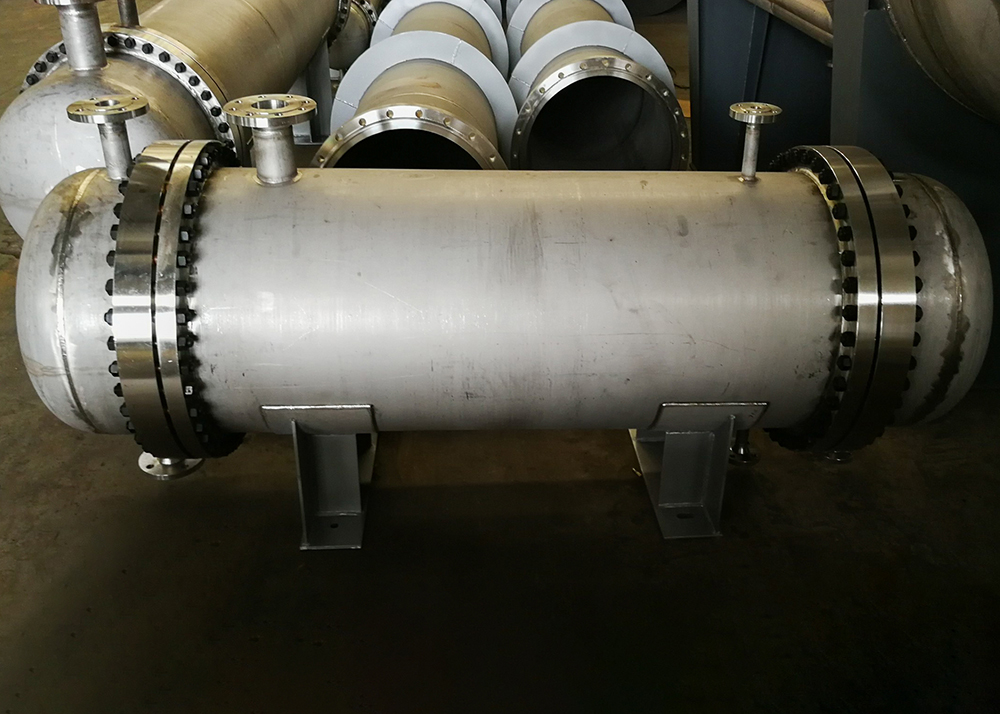
2. Thermal convection: During the flow of fluids in the tube and shell sides, heat is continuously carried from the high-temperature region to the low-temperature region, thereby achieving heat transfer. For tube side fluids, heat exchange occurs with the tube wall while flowing inside the tube; For the shell side fluid, it flows inside the shell and flushes the tube bundle, exchanging heat with the surface of the tube bundle. By designing components such as baffles reasonably, the turbulence level of the shell side fluid can be increased, the convective heat transfer coefficient can be improved, and the heat transfer effect can be enhanced.
In actual operation, heat conduction and convection coexist and interact with each other. Thermal conduction is the way heat is transferred in solids (pipe walls), while thermal convection is the way heat is transferred in fluids. The combined effect of the two enables tube and pipe heat exchangers to effectively exchange heat between two fluids, meeting the heating, cooling, condensation and other process requirements in various industrial processes.








 Service Hotline

 Hotline:0512-52093708
 E-mail:yutezjl@163.com
 Address:No. 101, Taojia Bridge, Dahe Village, Shanghu Town, Changshu City, Suzhou City, Jiangsu Province


 Add wechat
 Contact us
 Telephone